




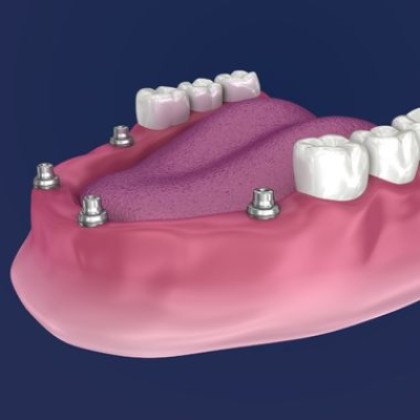


Losing several teeth, or even all of them, changes more than your smile. Eating becomes different. You might start avoiding certain foods, or find yourself thinking about your teeth when you're out with friends.
And then comes the question: dentures or dental implants?
Dentures have been around for a very long time, and plenty of people get on well with them. Dental implants are another option. They cost more, involve surgery and take longer, but they can give you teeth that feel much more secure.
So, are dental implants better than dentures?
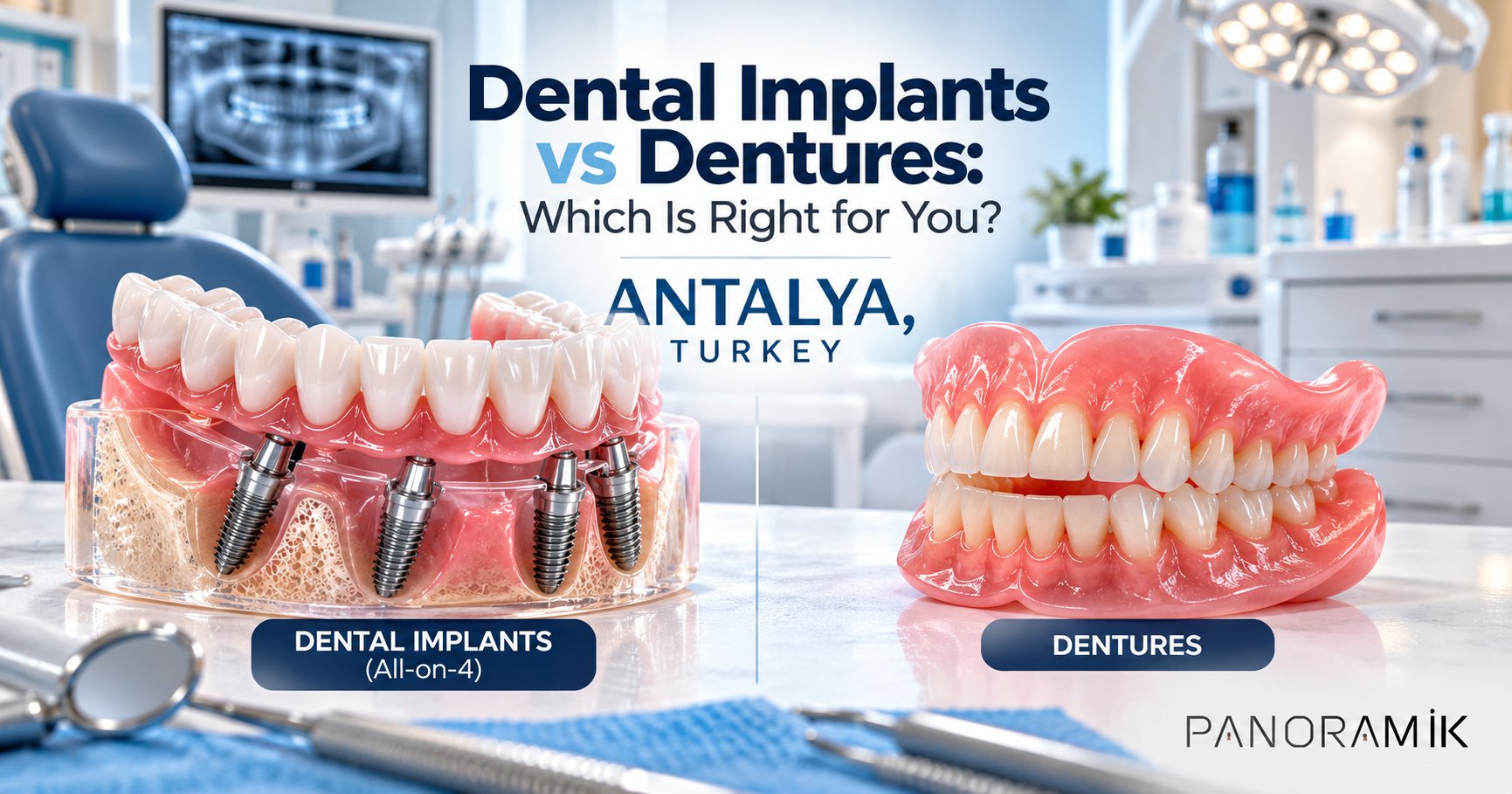
In terms of stability and chewing, fixed implant teeth generally have the advantage. They also help maintain the bone around the implants. Dentures, on the other hand, are more affordable, don't require surgery and can be made relatively quickly.
But there isn't one answer that works for everyone.
Your jawbone, your health, your budget and what you actually want from your new teeth all matter. Below, we'll look at the differences, including a few things that aren't always obvious until you've lived with dentures for a while.
What Are Dentures?
Dentures are removable teeth made to replace some or all of your missing teeth.
A full denture replaces a whole upper or lower set. The upper one usually covers the roof of your mouth as well. A partial denture is different. It fills the spaces left by missing teeth and often uses small clasps to attach to the teeth you still have.
Conventional dentures sit on your gums. Their fit, along with suction and sometimes a little adhesive, helps keep them in place.
You normally take them out at night, clean them and put them back in the next morning.
For many people, that's a perfectly manageable routine. The difficulty is that your gums and jawbone don't stay exactly the same shape over the years. A denture that once fitted comfortably can eventually become loose.
What Are Dental Implants?
A dental implant is a small titanium or zirconia fixture placed into your jawbone. It acts as a replacement for a missing tooth root.
After placement, the bone needs time to heal and bond with the implant. This is what gives it a firm foundation.
Once the implant is ready, your dentist can attach a crown, bridge or another type of replacement tooth.
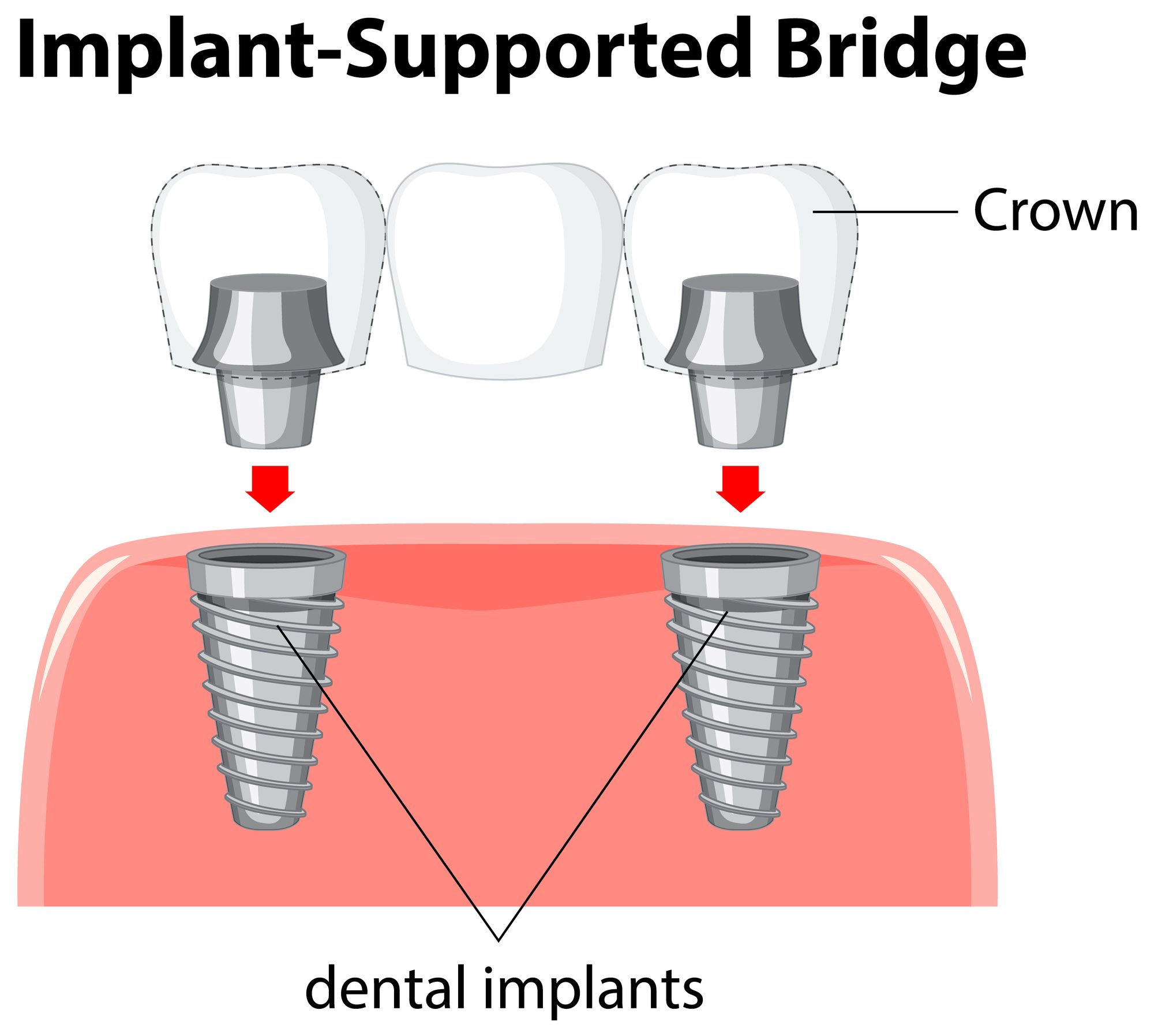
And if you've lost all your teeth, you don't necessarily need an implant for every single one. Treatments such as All-on-4 and All-on-6 use four or six implants to support a full set of fixed teeth.
Implants can also hold removable dentures in place. We'll come back to those later, because they can be a useful option for people who want something more secure without having a fully fixed bridge.
Dental Implants vs Dentures: What's the Difference?
Both treatments give you replacement teeth, but living with them can feel quite different.
Here's a quick comparison before we get into the details.
| Feature | Fixed Implant-Supported Teeth | Conventional Removable Dentures |
|---|---|---|
| Stability | Fixed teeth stay firmly in place | May move or loosen |
| Comfort | Generally secure once healed | Can cause rubbing or sore spots |
| Chewing | Usually stronger chewing support | Some foods can be difficult |
| Jawbone | Help maintain bone around implants | Don't prevent bone loss |
| Surgery | Required | Usually not required |
| Initial cost | Higher | Lower |
| Cleaning | Daily cleaning around the implants | Removed and cleaned separately |
| Longevity | Implants can last for decades | May need adjustments or replacement |
| Treatment time | Often several months | Usually quicker |
Stability and Comfort
Ask someone who's worn loose dentures what bothers them most, and there's a good chance they'll mention eating or talking.
A denture can shift when you bite into something. Lower dentures can be particularly troublesome because there's less surface to hold them in place.
Some people adapt very well. Others spend years worrying that their teeth might move when they laugh or eat in public.
Fixed implant teeth don't rely on suction or denture adhesive. They're attached to implants anchored in the jawbone, which makes them much more stable.
Of course, having implants doesn't mean you'll forget about your teeth completely. A new bridge can take some getting used to, and it still needs looking after.
But if you've been struggling with a denture that keeps slipping, having fixed teeth can feel like a big change.
Eating and Taste
Food is another area where the difference becomes noticeable.
With conventional dentures, biting into an apple or chewing a tough piece of meat can be difficult. Nuts, crusty bread and other hard foods may cause problems too.
It's not that you can't enjoy meals with dentures. Many people do. You may just need to cut food into smaller pieces or avoid certain things.
Upper dentures can also cover part or all of the palate. Some people find that this changes how they experience the taste, texture or temperature of food.
Fixed implant teeth generally give you better chewing support.
Once the implants have healed and the final teeth are fitted, many patients find they can eat a wider range of foods again.
There may still be foods you need to be careful with, especially very hard or sticky ones. Your dentist will explain what is suitable for your particular restoration.
What Happens to Your Jawbone?
This is one of the less obvious differences between dentures and implants.
Your natural tooth roots help transfer chewing forces into the jawbone. When a tooth is lost, the bone that used to support it gradually begins to shrink.
It doesn't happen overnight. It's a slow process, and you may not notice it at first.
Conventional dentures replace the visible teeth, but they don't replace the roots. So the bone underneath can continue to change.
That's one reason dentures sometimes become loose after a few years, even if they fitted well when they were first made.
Over time, significant bone loss can also affect the support around your lips and lower face.
Implants work differently. Because they're placed in the bone, they help maintain the bone immediately around them.
They don't stop every kind of bone loss, and they can't restore bone that's already disappeared. Still, preserving the bone around the implants is an important benefit.
Speech
When you first start wearing dentures, certain words might sound a little strange.
You may notice a slight lisp, or hear a clicking sound when you speak. Most people improve as they get used to their new teeth.
The problem is that a loose denture can make speaking uncomfortable again.
Fixed implant teeth tend to stay more secure, so there's less movement to worry about.
Depending on the design, they may also leave more of the roof of your mouth uncovered.
You'll still need a little time to adjust to the shape of your new teeth. That's normal, whether you choose implants or dentures.
Cleaning and Daily Care
Dentures and implants both need regular cleaning, but the routine is different.
With conventional dentures, you take them out, clean them with suitable products and look after your gums separately. They're generally removed overnight too.
Fixed implant teeth stay in your mouth.
You brush them and clean around the implants with the tools your dentist recommends. If you have a full-arch bridge, cleaning underneath it is particularly important.
One thing worth remembering: implants can't get cavities, but the tissues around them can still become inflamed.
If plaque builds up, it can lead to gum inflammation and, in more serious cases, problems with the supporting bone.
So implants aren't a way to escape dental hygiene. They need care, just in a different way, including regular professional cleaning.
How Long Do They Last?
A well-made denture can serve you for years, but it probably won't fit exactly the same forever.
As your gums and jawbone change, the denture may need relining, adjusting or eventually replacing.
Implants are intended to be a long-term solution. Many last for decades, particularly when patients maintain good oral hygiene and attend regular dental appointments.
But there's no lifetime guarantee.
Smoking, gum disease, poor cleaning and certain health conditions can all affect implant survival.
And remember, the implant itself and the tooth attached to it are two different things. A crown or bridge may wear out or become damaged even when the implant underneath is still healthy.
Cost: Implants vs Dentures in Turkey
Dentures usually cost less initially. Implant treatment involves surgery, components and a separately made restoration, so an implant fixture price should never be compared with the price of a complete denture as though both covered the same treatment.
The following guide uses Panoramik's published treatment price list for implant components. Conventional denture costs are an indicative Turkey budget range based on advertised prices from other clinics because Panoramik does not list a denture fee.
| Treatment or component | Price | Scope |
|---|---|---|
| Conventional full removable denture | Approximately £400–£600 per jaw | Turkey budgeting guide, not a Panoramik quote; materials, extractions and adjustments can change the cost. |
| Implant fixture | £270–£750 per implant | Panoramik's listed range across implant brands; the abutment and replacement tooth are listed separately. |
| Abutment | £50–£129 per implant | Connector between the implant and restoration; confirm the component required for your plan. |
| Individual crown | £90–£170 per crown | Published crown range by material; confirm suitability and the implant-supported restoration fee in your quote. |
| Fixed full-arch bridge or removable implant-retained denture | Individual quotation | Requires the complete implant, attachment and prosthesis plan; a fixture price alone is not a full-arch package price. |
The denture estimate is a rounded planning range informed by the published fees at Smile Dental Turkey and Betadent. It is not a national statistical average. All source prices used here were already in GBP, so no currency conversion was needed.
Ask for a written, itemised quote covering scans, extractions, any bone grafting, implants, abutments, temporary teeth and the final restoration. Confirm whether travel, accommodation, follow-up care and repairs are included. A single-tooth restoration and a full-arch bridge need different treatment plans; our guide to the price for a single implant explains the former.
Both options have ongoing costs. Dentures can need relining, repairs or replacement; implant restorations need professional maintenance and may also need repairs. Our guide to why dental treatment is cheaper in Turkey explains the wider cost differences.
Treatment Time
If you want replacement teeth without surgery, dentures are generally the quicker route.
Implants take more time.
After the implants are placed, the bone needs to heal around them. Bone healing commonly takes three to six months and can take longer, particularly when additional procedures are needed. Our guide to recovery after dental implants explains what to expect.
For patients travelling to Antalya, treatment often involves two separate trips with a healing interval between them. Each trip includes several appointments; the months of healing do not normally mean staying in Turkey throughout.
During the first visit, we carry out the planned surgery. In suitable full-arch cases, temporary fixed teeth can be fitted shortly afterwards.
That isn't possible for every patient, though. Sometimes the implants need to heal without immediate loading.
Once healing is complete and your dentist has confirmed the implants are ready, you return for the final teeth. Ask for the number of days required for each trip in your written plan before booking flights; grafting or a staged restoration may require extra visits.
Your dentist should explain the expected timeline before you commit to treatment, including what you'll be wearing while everything heals. See how many days to stay in Turkey for dental treatment for typical stay lengths.
What Are the Disadvantages of Dental Implants?
It's easy to focus on the benefits of implants, especially if you've been unhappy with dentures for years.
But there are downsides, and they're worth understanding.
First, implants involve surgery. Most patients manage the procedure and recovery well, but swelling, soreness and bruising can occur afterwards.
There are also possible complications. An implant may fail to bond with the bone, an infection can develop, or nearby structures may be affected during surgery.
These problems don't happen to everyone, but they're real risks. Our article on the signs of a failed implant explains what to look out for.
Then there's the waiting. If you need bone grafting or additional healing time, treatment can take longer than you expected.
And even after everything is finished, implants still need maintenance. Inflammation around an implant can become serious if it's ignored.
The higher initial cost is another consideration.
None of this means implants are a bad choice. It simply means you should understand what the treatment involves, not just what the finished smile might look like.
What Are the Disadvantages of Dentures?
Dentures have their own frustrations.
For some people, the biggest issue is the feeling that their teeth aren't quite secure. They may avoid biting into certain foods or feel uncomfortable eating in company.
Others struggle with sore gums, food getting trapped underneath or needing adhesive to keep the denture in place.
And because the jawbone continues to change after tooth loss, dentures often need adjustments as the years pass.
That said, not everyone has these problems.
Some patients have worn dentures comfortably for a long time and see no reason to change. If they fit well, allow you to eat properly and don't cause discomfort, they may be doing exactly what you need.
The Middle Ground: Implant-Supported Dentures
There's another option that doesn't always get as much attention.
Implant-supported dentures, often called snap-on dentures or overdentures, are removable dentures held in place by implants.
Instead of relying entirely on the gums for support, they attach to implants using special connectors.
You can still take the denture out to clean it, but it generally feels much more secure when you're wearing it.
This can be particularly helpful with lower dentures, which are often harder to keep stable.
The number of implants depends on your jawbone and the type of denture being planned. Some lower overdentures can be supported by two implants, while other designs need more.
For patients who want better stability but don't necessarily want a fully fixed bridge, it's an option worth discussing.
All-on-4 vs Dentures
If you've lost all the teeth in one jaw, you may have come across All-on-4.
Both All-on-4 and full dentures replace a complete arch of teeth, but they don't work in the same way.
With a conventional denture, the teeth rest on the gums and you remove them yourself.
With All-on-4, four implants support a fixed bridge. The bridge stays in your mouth and is only removed by a dental professional when necessary.
Two of the implants are often placed at an angle towards the back of the jaw. This helps make use of the available bone and may avoid the need for grafting in some cases.
But All-on-4 isn't suitable for everyone with bone loss. Your dentist still needs to check the amount and position of the bone, along with your bite and general oral health. If you're weighing up the fixed options, our comparison of All-on-4 vs All-on-6 in Antalya and our page on full mouth implants may help.
For someone who's spent years dealing with a loose denture, the stability of a fixed bridge can be a major reason to consider it.
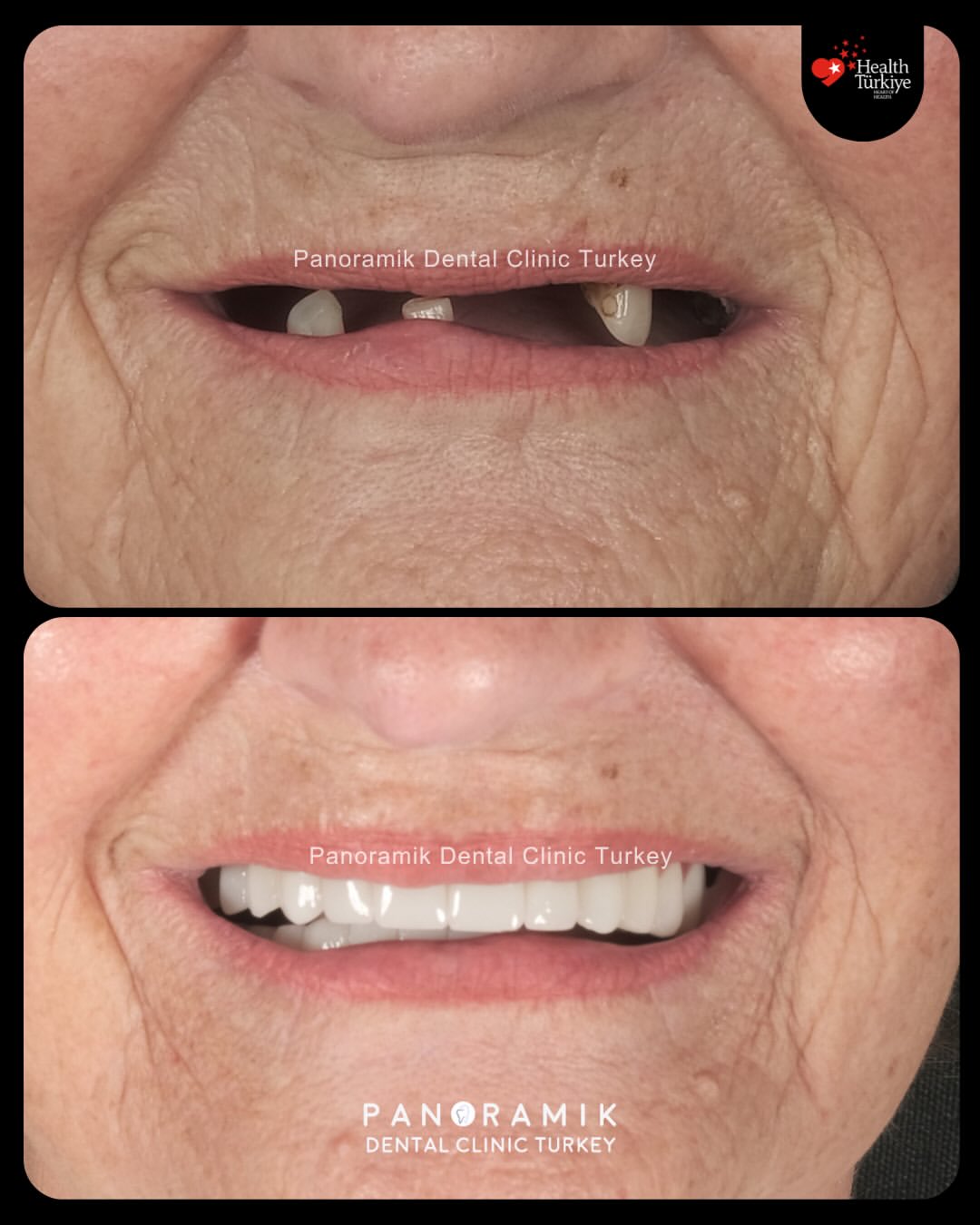
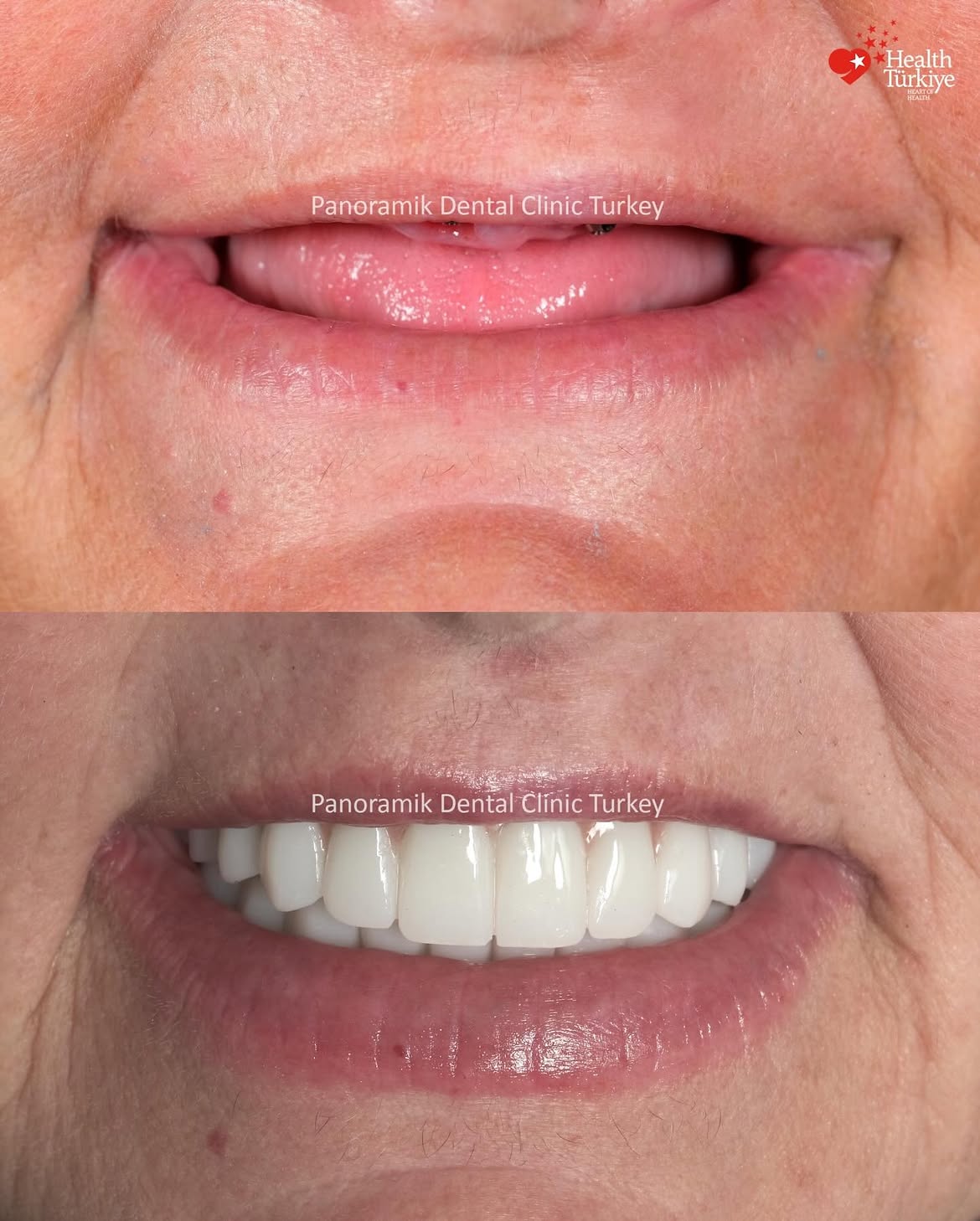
Before and after: two full-arch implant restorations at Panoramik Dental Clinic in Antalya. Results can vary from person to person.
Who Is a Good Candidate for Dental Implants?
You don't need to be young to have implants. Age on its own isn't usually the deciding factor.
What matters more is your general health, the condition of your gums and whether there's enough suitable bone to support the implants.
Smoking can affect healing. So can uncontrolled diabetes and certain medications or medical treatments.
Active gum disease also needs attention before implant treatment is planned, and periodontal treatment may come first.
If you've worn dentures for many years, you may have lost some of the bone that once supported your natural teeth.
That doesn't automatically rule out implants.
Sometimes a bone graft can help. In other cases, a different implant arrangement may be possible.
We look at your medical history, examine your mouth and use appropriate imaging, often including a 3D CBCT scan, to understand what can safely be done.
A scan is important, but it's only one part of the assessment.
When Dentures Might Still Be the Better Choice
Not everyone needs implants.
If surgery would carry significant risks because of your health, conventional dentures may be the safer option.
They may also make more sense if your budget is limited or if you're comfortable with removable teeth and don't feel the need for something fixed.
And that's fine.
There's no point recommending a more complicated treatment simply because it's available.
Some people choose dentures first and consider implants later. That can be an option, although continued bone loss may make future implant treatment more difficult.
The best decision is the one that suits your circumstances, not necessarily the most expensive one.
Switching From Dentures to Implants in Antalya
If you've been wearing dentures and are thinking about changing to implants, you don't have to decide everything before visiting us.
A good starting point is to send us a recent panoramic X-ray or CT scan, if you have one, along with a few photographs.
We can use these to get an initial idea of your situation and discuss what might be possible.
It's not a final treatment plan. That comes after a proper examination.
When you arrive at Panoramik Dental Clinic in Antalya, we check your gums, assess your bite and take the scans needed for implant planning.
If implants are suitable, we'll explain how many you may need, what type of teeth could be fitted and whether any additional procedures are necessary.
Some patients can have implants placed and temporary fixed teeth fitted during the first visit. Others need more healing time or a different treatment sequence.
After the implants have healed, the final teeth are made and fitted.
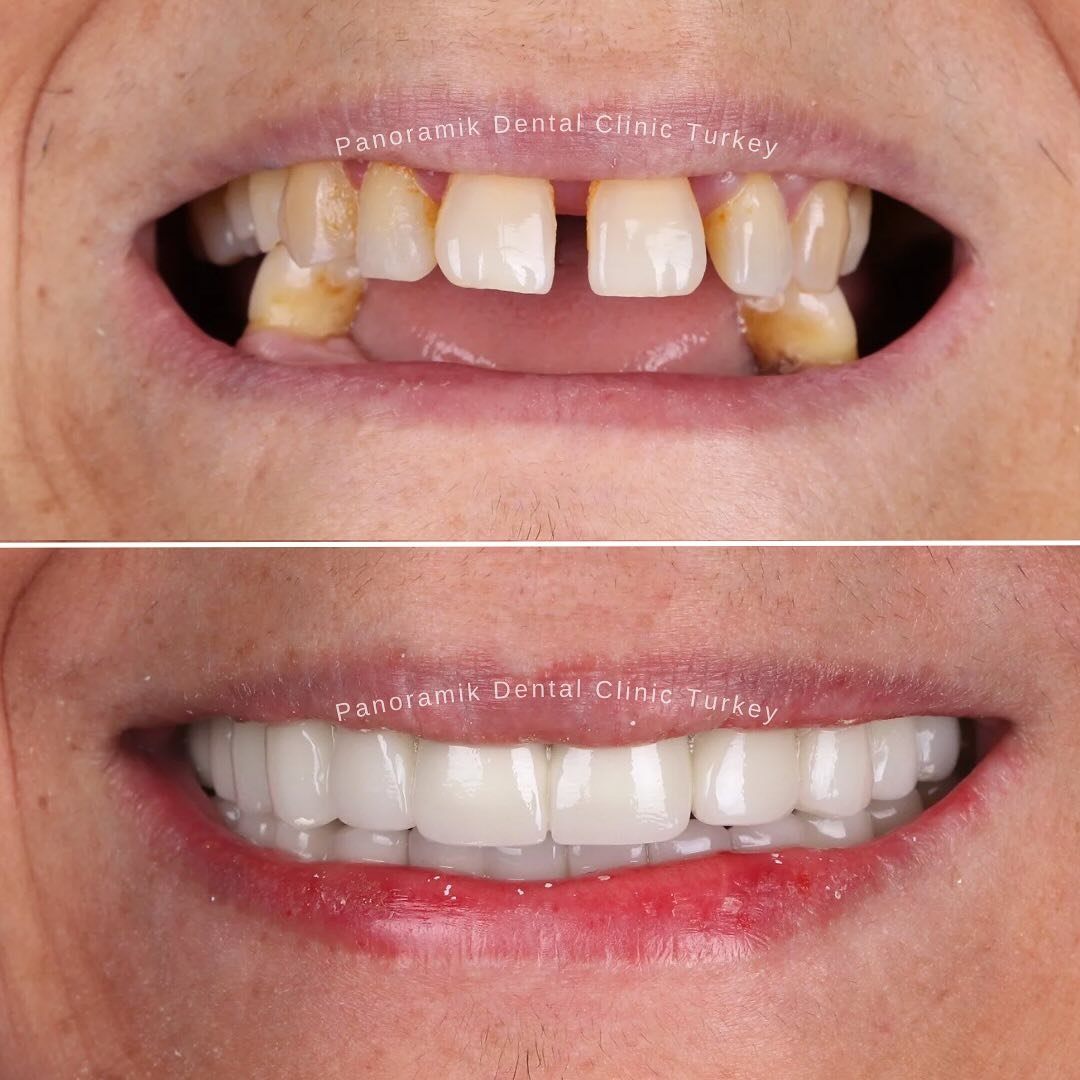
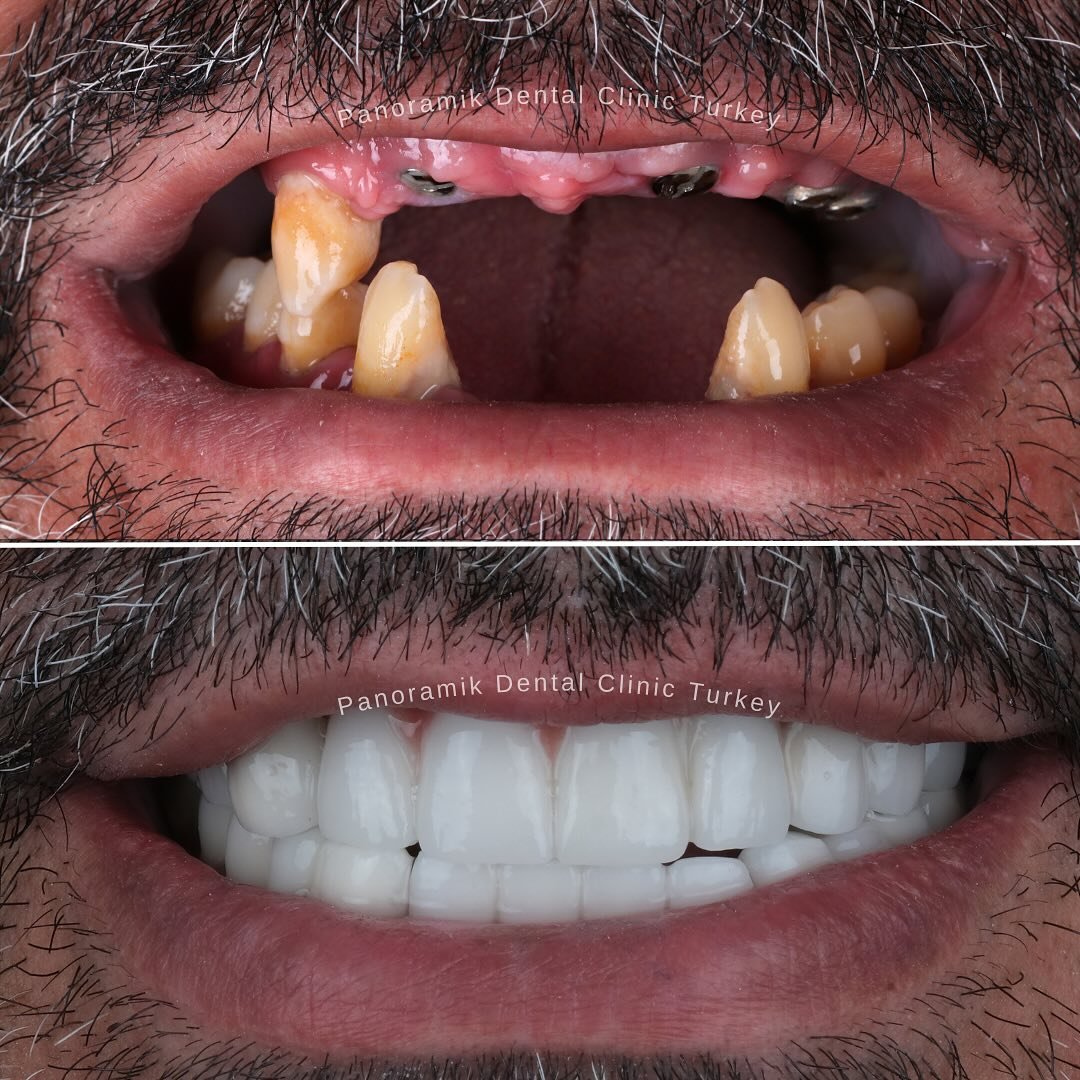
Before and after: missing teeth replaced with fixed implant teeth at Panoramik Dental Clinic in Antalya. Results can vary from person to person.
We also explain how to clean and maintain your new teeth, and what to do if you have a concern after returning home.
For what a typical trip looks like, read our day-by-day guide to dental tourism in Antalya. You'll find answers to more common questions in our dental implant FAQs, and tips on comparing clinics in how to choose the best dental clinic in Turkey.
Talk to Us About Your Options
Maybe you're tired of a denture that moves when you eat. Or perhaps you're simply trying to work out whether implants are worth the extra cost.
Whatever has brought you here, you don't need to make the decision based on price or appearance alone.
At Panoramik Dental Clinic in Antalya, we can help you understand the differences between conventional dentures, implant-supported dentures and fixed implant teeth.
If you have recent X-rays or photographs, you're welcome to send them to our team for an initial review.
We'll explain what may be possible and what needs to be checked in person before you decide on treatment.
Contact us on WhatsApp | Book a consultation in Antalya
Frequently Asked Questions
Implant surgery is normally carried out under local anaesthetic, so you shouldn't feel pain during the procedure, although you may feel pressure. Some soreness and swelling afterwards are expected. Dentures don't require implant surgery, but they can cause sore spots when they're new or no longer fit properly. The two treatments involve different kinds of discomfort.
Possibly, yes. Many people have implant treatment after years of wearing dentures. The main concern is how much jawbone remains. Some patients have enough bone for implants, while others may need grafting or a different approach. Your dentist will need to examine you and review appropriate scans before making a recommendation.
In some cases, an existing denture can be adapted to attach to implants. It depends on its condition, fit and design. If the denture is old or no longer fits properly, making a new implant-supported denture may be a better choice. Your dentist can assess whether adapting it is practical.
There's no single number for everyone. Fixed full-arch bridges may use four, six or more implants, depending on the treatment plan. A removable implant-supported denture may need fewer. The right number depends on your bone, bite and the type of replacement teeth you want. Our comparison of All-on-4 vs All-on-6 explains the options in more detail.
For some patients, the lower cost of implant treatment in Turkey makes it an option they couldn't afford at home. But the price is only part of the decision. You'll also want to know who is carrying out the treatment, which implant system is being used, how long you'll need to stay and what happens if you need help after returning home.
Not necessarily. Plenty of older adults can have implants, provided their health and jawbone are suitable. Others may prefer dentures because they don't want surgery or have medical conditions that make implants less appropriate. Age matters less than your overall health and individual needs. See also our guide to dental health over 50.
That depends on the type. Fixed implant bridges stay in your mouth overnight. Removable implant-supported dentures are generally taken out before bed, unless your dentist advises otherwise. This gives you a chance to clean the denture properly and allows the gums to rest.
Implants cost more initially, involve surgery and take longer to complete. There's also a risk of infection, implant failure or problems with the surrounding gums and bone. Some patients need additional procedures before implants can be placed. Dentures avoid implant surgery, although they may be less stable and need adjustments over time.
Yes, many people do. Wearing dentures for years doesn't automatically mean implants are no longer possible. However, the jawbone may have changed since your teeth were lost. A clinical examination and suitable scans will show whether implants are an option and whether any additional treatment is needed.
Sources and Further Reading
Written by: Panoramik Dental Clinic. Updated: .
Dental reviewer: Hüseyin Gürel, Dentist, Panoramik Dental Clinic.