




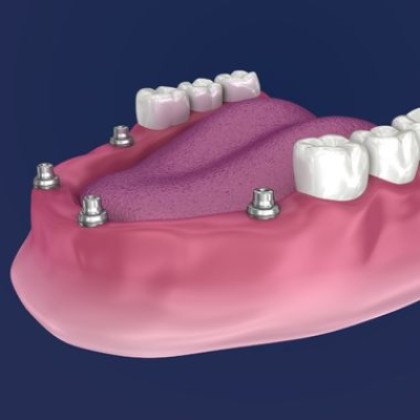


Many people are told at some point that they "don't have enough bone" for dental implants. For a lot of them, that sentence feels like the end of the conversation. They assume dentures are the only option left and stop looking.
In most cases, that isn't true. Bone loss does make implant treatment more involved, but it rarely rules it out completely. Modern implant dentistry has several ways of working with a thin or shrunken jaw, from bone grafting and sinus lifts to angled implants and, in more advanced cases, zygomatic implants.
This guide explains what your options are if you have jawbone loss, how dentists decide which approach suits you, and what to expect if you are thinking about treatment in Antalya, Turkey.
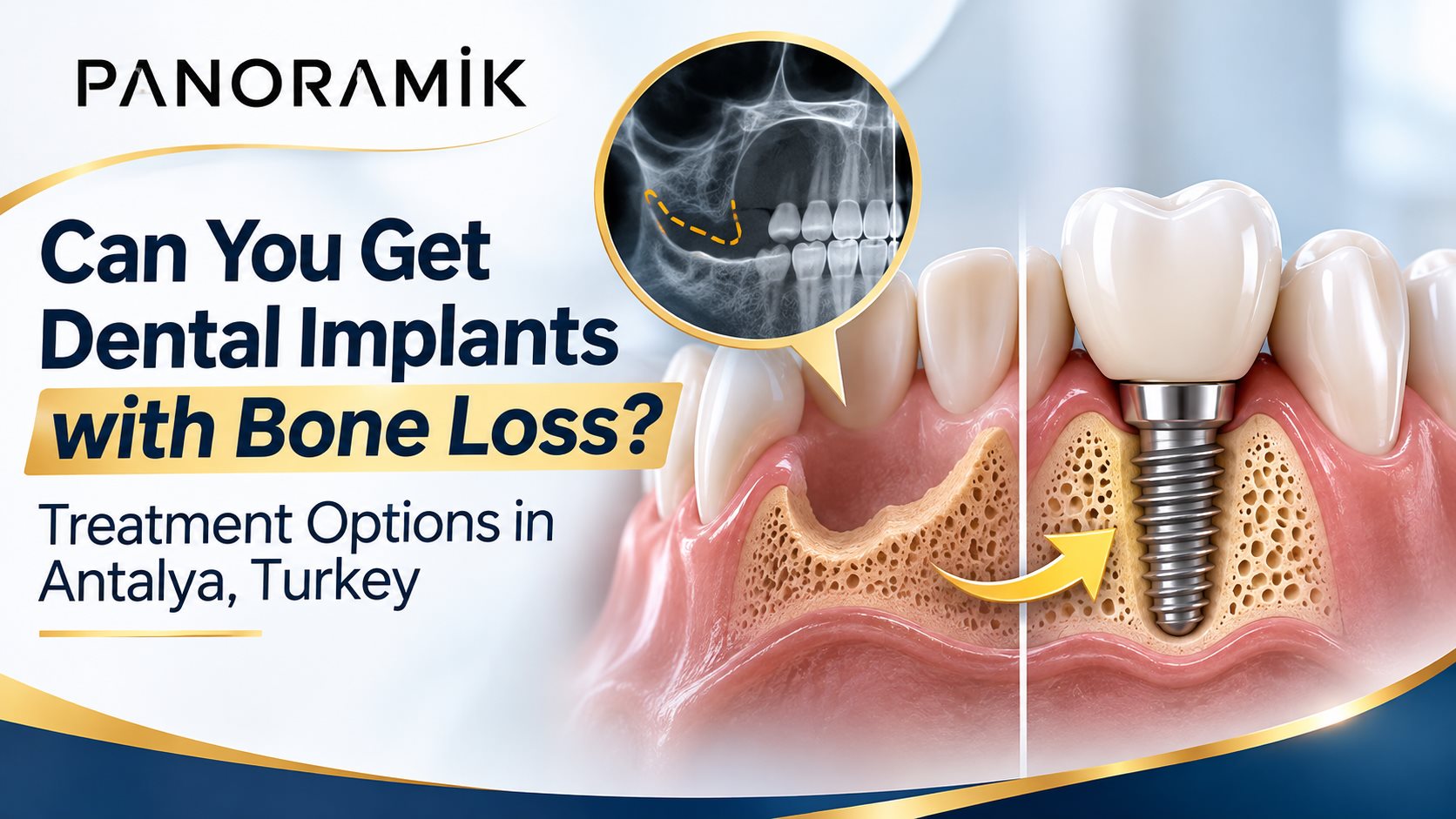
Can You Get Dental Implants If You Have Bone Loss?
Yes, most patients with bone loss can still get dental implants. The real question is how.
A dental implant is a small titanium post that is placed into the jawbone, where it fuses with the bone over a few months. To stay stable for years, it needs enough healthy bone around it. When the bone is too thin, too short or too soft, the dentist has two broad choices: rebuild the bone, or plan the implants so they use the bone that is still there.
Which of these makes sense depends on how much bone you have lost, where the loss is, and how many teeth you need to replace. Someone missing a single tooth with mild bone loss is in a very different situation from someone who has worn dentures for fifteen years and has lost a large amount of bone across the whole upper jaw.
How Much Jawbone Is Needed for Dental Implants?
There is no single number that applies to everyone, because implants come in different lengths and widths. As a general guide, a standard implant needs enough bone height to hold its full length and enough width so that a layer of bone surrounds it on both sides.
Bone quality matters as much as quantity. The lower jaw is usually denser, while the back of the upper jaw tends to be softer and is also limited by the maxillary sinus sitting just above the roots of the back teeth.
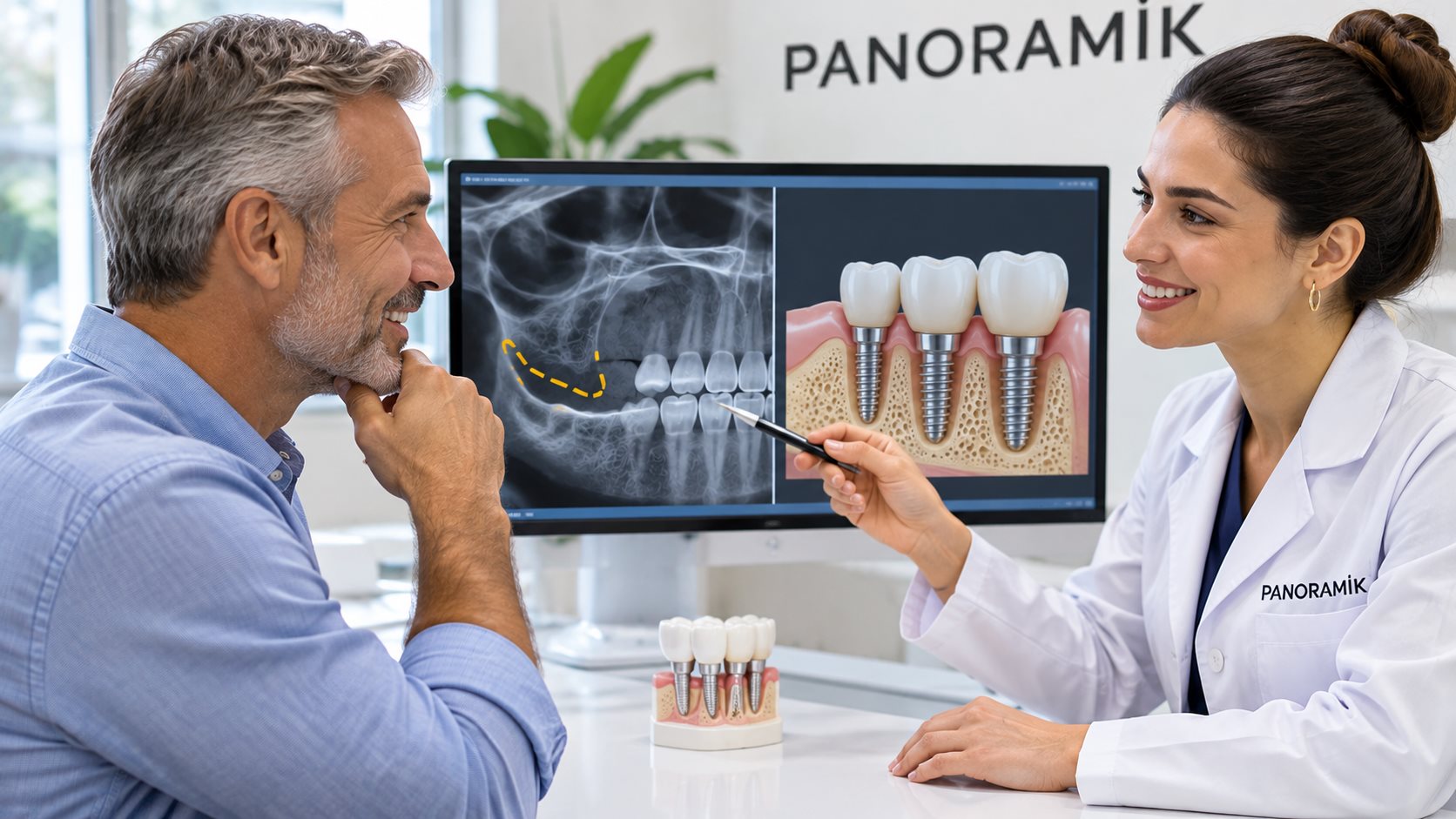
This is why a normal X-ray is not enough to plan implants for someone with bone loss. At Panoramik Dental Clinic, implant planning is based on a CBCT scan, a 3D image that shows the exact height, width and density of your jawbone, along with the position of the nerves and sinuses. That scan is what tells the dentist whether you need a graft, a sinus lift, a different implant angle or a completely different technique.
What Causes Jawbone Loss?
The jawbone needs regular stimulation to stay healthy. Tooth roots provide that stimulation every time you chew. When a tooth is lost, the bone in that area slowly starts to shrink because it is no longer being used. Our guide to bone loss in teeth explains this process in more detail.
The most common causes include:
- Missing teeth that were never replaced, especially if they were lost years ago.
- Long-term denture use, since dentures rest on the gums and do not stimulate the bone underneath.
- Advanced gum disease (periodontitis), which destroys the bone that supports the teeth. Read more about dental implants with gum disease.
- Infections or failed root canal treatments.
- Difficult extractions or injuries to the jaw.
- Natural anatomy, such as a large sinus in the upper jaw.
The longer a gap has been left untreated, the more bone is usually lost. That is one reason dentists often recommend replacing missing teeth sooner rather than later.
Dental Implant Options for Patients with Bone Loss
There is no single "bone loss implant". Instead, there are several approaches, and the right one depends on your scan and your goals.
- Bone grafting: Bone graft material is added to the area to rebuild height or width. Once it has integrated, a standard implant can be placed. Small grafts can sometimes be done at the same time as the implant.
- Sinus lift: In the upper back jaw, the sinus floor is gently raised and bone graft material is placed underneath. This creates enough height for implants where there was not enough before.
- Short or narrow implants: In some cases, shorter or slimmer implants can fit into limited bone without the need for grafting.
- Angled implants and All-on-4 or All-on-6: For full-arch cases, implants can be tilted to make use of the strongest bone at the front of the jaw, often avoiding major grafting.
- Zygomatic implants: For severe bone loss in the upper jaw, long implants are anchored in the cheekbone instead of the jawbone.
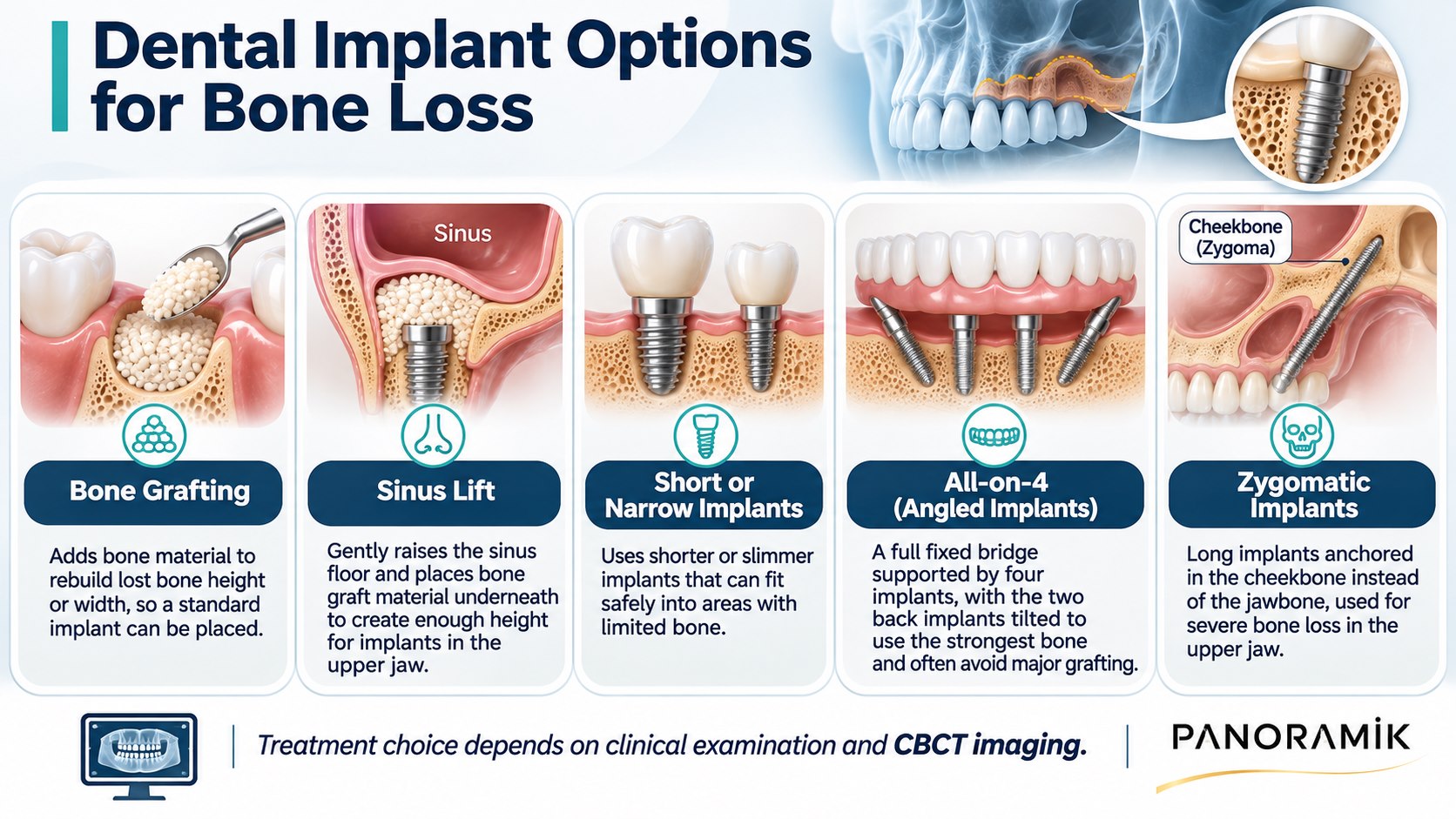
Your dentist may combine more than one of these. For example, a patient might need a small graft on one side and a sinus lift on the other.
Can You Get Dental Implants Without Bone Grafting?
Sometimes, yes. Many patients ask this because they want to avoid extra surgery and a longer healing time, which is completely understandable.
Grafting may be avoidable when:
- The bone loss is mild and a shorter or narrower implant can be used safely.
- The implants can be angled into denser bone, as in All-on-4 treatment.
- The upper jaw has lost so much bone that zygomatic implants are a better option than large grafts.
That said, skipping a graft should never come at the cost of long-term stability. If an implant is placed in bone that cannot support it, the risk of failure goes up. In some cases a graft is simply the safer path, and a good dentist will tell you so honestly rather than promise a shortcut.
All-on-4 Dental Implants for Patients with Bone Loss
All-on-4 is one of the most popular solutions for people who have lost all or most of their teeth in one jaw. A full fixed bridge is supported by four implants. The two front implants are placed straight, while the two back implants are tilted.
That tilt is what makes All-on-4 useful for bone loss. By angling the back implants, the dentist can avoid the sinus in the upper jaw and the nerve in the lower jaw, and anchor the implants in the denser bone towards the front. Many patients who were told they needed extensive grafting are able to have All-on-4 without it.
However, All-on-4 is not suitable for every case. If there is not enough bone even at the front of the jaw, or if the bone is very soft, the dentist may suggest All-on-6, additional grafting, or zygomatic implants instead. The decision comes from the CBCT scan, not from a standard package. Our comparison of All-on-4 vs All-on-6 explains the differences.
When Are Zygomatic Implants Considered?
Zygomatic implants are reserved for advanced bone loss in the upper jaw. Instead of relying on the jawbone, these longer implants pass through the back of the upper jaw and anchor into the zygomatic bone, better known as the cheekbone, which is very dense and usually stays intact even when the jaw has shrunk.
They are typically considered when:
- There is severe bone loss in the upper jaw.
- Previous grafts or implants have failed.
- The patient wants to avoid multiple grafting procedures and a long waiting period.
Zygomatic implant surgery is more complex than standard implant placement and requires an experienced surgical team. Possible complications include sinusitis, infection, and problems with the bridge or its screws. Your surgical team should explain the risks, benefits and alternatives for your case before treatment. It is not the first choice for everyone, but for the right patient it can make fixed teeth possible where they otherwise would not be.
Bone Grafting and Sinus Lifting: When Are They Necessary?
Bone grafting is usually recommended when the bone is too thin or too short in a specific area and there is no safe way to plan around it. It is common for single implants and small bridges, where angled implant techniques are not practical.
The graft material can come from different sources, including synthetic materials, processed bone from other sources, or occasionally the patient's own bone. Over time, your body replaces the graft with its own new bone.
A sinus lift is a specific type of graft for the upper back teeth. Once a molar is lost in that area, the sinus often expands downward while the bone shrinks upward, leaving very little height for an implant. Lifting the sinus membrane and placing graft material beneath it restores that height.
Depending on the amount of bone available, these procedures can sometimes be done on the same day as implant placement. In other cases, the graft needs to heal first.
How Long Does Implant Treatment Take with Bone Loss?
Treatment time depends on the approach.
If no graft is needed, or only a small graft is placed alongside the implant, the process usually follows a normal implant timeline: implant placement on the first visit, a healing period of around three to six months, and then the final crowns or bridge on a second visit.
If a larger graft or sinus lift is needed before implants can be placed, the graft usually needs several months to heal first. This adds an extra stage to the treatment.
With All-on-4 and zygomatic implants, temporary fixed teeth may be fitted within a few days of surgery if the implants have sufficient initial stability and the clinical conditions are suitable. If immediate loading is not appropriate, your dentist will discuss a temporary removable option or another interim plan while the implants heal. The permanent bridge is fitted after the healing period.
For international patients whose implants can be placed without a separate graft-healing stage, treatment often involves two trips to Antalya: one for the examination, scan and implant surgery, and another for the final teeth. If a bone graft or sinus lift must heal before implant placement, an additional surgical stage and extra trips may be needed. Your treatment plan will show how long each stay is likely to be, and our guide to how many days you need to stay in Turkey can help you plan each trip.
Dental Implant Costs for Patients with Bone Loss in Antalya
The cost of implant treatment with bone loss varies more than standard implant treatment, because it depends on several factors:
- The number of implants needed.
- Whether bone grafting or a sinus lift is required, and how extensive it is.
- The implant brand and system used.
- The type of final restoration, such as zirconia crowns or a full-arch bridge.
- Whether advanced techniques like zygomatic implants are needed.
Many patients from the UK, Europe and other countries choose Antalya because treatment costs are often considerably lower than at home, while modern equipment, CBCT imaging and experienced implant dentists are available. It is also easy to combine treatment with a stay in one of Turkey's best known coastal cities. You can find general information on dental implants in Turkey on our treatment page.
The most reliable way to understand your cost is to share a recent panoramic X-ray or CBCT scan with the clinic. This allows the team to give you a realistic, personalised treatment plan rather than a generic price. Contact us to request yours.
Frequently Asked Questions
Often, yes. Long-term denture wearers usually have some degree of bone loss, but All-on-4, grafting or zygomatic implants can still make fixed teeth possible. A CBCT scan will show which option suits you.
Bone grafting is done under local anaesthesia, so you should not feel pain during the procedure. Some swelling and discomfort for a few days afterwards is normal and is usually managed with standard painkillers.
When planned and placed by an experienced team, zygomatic implants have shown good long-term results. Like all implants, they need good oral hygiene and regular check-ups.
Implants help keep the bone stimulated, which slows further loss. However, gum disease around implants, smoking and poor oral hygiene can still cause bone loss over time, so ongoing care is important.
You will only know after a clinical examination and a CBCT scan. Every jaw is different, and a plan that works perfectly for one patient may not be suitable for another.
Find Out What Your Options Are
Being told you have bone loss does not mean you have to give up on fixed teeth. In many cases, it simply means your treatment needs more careful planning.
If you have been told you are not a candidate for implants, or you are not sure how much bone you have, contact Panoramik Dental Clinic in Antalya. Send us your X-ray or scan, and our team will review your case and explain which treatment options may be suitable for you.
Contact us on WhatsApp | Book a consultation in Antalya
Written by: Panoramik Dental Clinic. Updated: .
Dental reviewer: Hüseyin Gürel, Dentist, Panoramik Dental Clinic.